Strength of UV rays

Enjoy winter breaks but remember to protect your skin from the sunThis page contains information about how different conditions affect your exposure to UV radiation. Click on the links below to read about specific topics.

You can find out more about the evidence behind other health topics in our other How do we know? pages.

UV exposure varies with the time of day and time of year

In the UK, UV radiation is most intense in summer from 11am to 3pm and several groups recommend limiting exposure to the sun during these times 1, 2. Remember the shadow rule: when your shadow is shorter than your height, you are more likely to burn 3.

In the UK, sun protection is most important from April to September 4. During these months, the UK sun can be more than capable of burning skin.

A lot of holiday destinations abroad have higher levels of ultraviolet radiation than the UK, so it can take less time to burn. Also remember that solar noon can be different in some countries such as Spain.

Skiers and snowboarders should take extra care on the slopes

Even though it may feel very cold on the mountain, skiers and snowboarders should take extra care in the sun. Spending time at high altitude increases UV exposure by about 15% for every 1000 metres 5, 6.

Snow can reflect up to 85% of the UV radiation that hits it, increasing your exposure. People still need protection when the sky is cloudy as UV rays can bounce back and forth between the snow and the clouds 7.

You can burn on a cloudy day, underwater, or through a window

Untreated glass, water and clouds are not good shields against UV radiation. Most glass and plastic block out UVB rays, but UVA rays can still come through 8. UVA rays can also damage DNA and cause skin ageing.

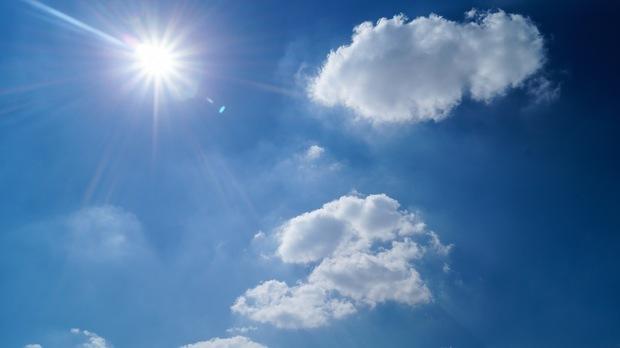
Even on overcast skies, 30-40% of UV will still penetrate through cloud cover 9-11. For example, if half the sky is covered in clouds, 80% of UV still shines through 9.

About 75% of sunburning rays are reflected back from snow, 15% from sand, 10% from concrete and 5-10% from water (depending on choppiness) 12. So you may be exposed to UV rays even when you’re in the shade.

References

  1.  IARC, Sunscreens. IARC Handbooks of Cancer Prevention. Vol. 5. 2001, Lyon: IARCPress.
  2.  Health Protection Agency, UV Index Graphs Link
  3.  Holloway, L., Shadow method for sun protection. Lancet, 1990. 335: p. 484. PubMed
  4.  Diffey, B., Is daily use of sunscreens of benefit in the U.K.? Br J Dermatol, 2002. 146: p. 659-62. PubMed
  5.  IARC, Solar and ultraviolet radioation. Monographs on the evalutation of carcinogenic risks to humans. 1992, Lyon: IARCPress.
  6.  Schumucki, D. and R. Philipona, Ultraviolet radiation in the alps: The altitude effect. Optical Engineering, 2002. 41(12). PubMed
  7.  Renaud, A., et al., Influence of snow and clouds on erythemal UV radiation: Analysis of Swiss measurements and comparison with models. Journal of Geophysical Research D: Atmospheres, 2000. 105(D4): p. 4961-4969. PubMed
  8.  Heffernan, A. and A. O'Sullivan, Pediatric sun exposure. Nurse Pract, 1998. 23: p. 67-86. PubMed
  9.  Schafer, J.S., et al., Observed influence of clouds on ultraviolet-B radiation. Geophys Res Lett, 1996. 23(19): p. 2625-2628. PubMed
  10.  Chen, D., et al., Attenuation of biologically effective UV doses under overcast skies: A case study from the eastern Atlantic sector of the Southern Ocean. Deep-Sea Research Part II: Topical Studies in Oceanography, 2004. 51(22-24): p. 2673-2682. PubMed
  11.  Lee, Y., et al., Effects of ozone, cloud and snow on surface UV irradiance. Ocean Polar Res, 2004. 26(3): p. 439-451. PubMed
  12. Feister, U. and Grewe, R., Spectral Albedo Measurements in the UV and Visible Region Over Different Types of Surfaces. Photochem Photobiol, 1995. 62(4): p.736-744. Journal